“The study is to proceed on the basis of the conjecture that every aspect of learning or any other feature of intelligence can in principle be so precisely described that a machine can be made to simulate it. An attempt will be made to find how to make machines use language, form abstractions and concepts, solve kinds of problem now reserved for humans, and improve themselves.”
\(~\) – Proposal for the Dartmouth AI program, 1956
This manuscript has established that the common and fundamental problem behind intelligence is to learn parsimonious and structured representations of low-dimensional distributions in a high-dimensional space. From this perspective, we have systematically introduced mathematical principles and computational mechanisms for how such representations can be learned and developed from observed data as information and knowledge. The ability to autonomously seek and discover structure and parsimony in a seemingly random world is a fundamental characteristic of any intelligence, natural or artificial. We believe the principles and mechanisms presented in this book are unifying and universal, applicable to both animals and machines.
We hope this book helps readers fully clarify the mystery surrounding modern practices of artificial deep neural networks by developing a rigorous understanding of their functions and roles from the perspective of learning structured representations of low-dimensional distributions from high-dimensional data. With this understanding, the capabilities and limitations of existing AI models and systems become clear:
One goal of this book is to help readers establish an objective and systematic understanding of current machine intelligence technologies and to recognize what open challenges hence opportunities remain for further advancement of machine intelligence. In the last chapter, we provide some of our views and projections for the future.
From the practice of machine intelligence in the past decade, it has become clear that, given sufficient data and computational resources, one can build a large enough model and pre-train it to learn the prior distribution of all the data, say \(p(\vx )\). Theoretically, such a large model can memorize almost all existing knowledge about the world that is encoded in data such as 2D images, 3D shapes, dynamical motions, and natural languages. As we discussed at the beginning of the book, such a large model plays a role similar to DNA, which life uses to record and pass on knowledge about the world.
The model and distribution learned in this way can then be used to create new data samples drawn from the same distribution. One can also use the model to conduct inference (e.g., completion, estimation, and prediction) with the memorized knowledge under various conditions, say by sampling the posterior distribution \(p(\vx \mid \vy )\) under a new observation \(\vy \). Strictly speaking, such inference is inductive or statistical.
Any pre-trained model, however large, cannot guarantee that the distribution it has learned so far is entirely correct or complete. If our samples \(\hat {\vx }_{t}\) from the current prior \(p_{t}(\vx )\) or estimates \(\hat {\vx }_{t}(\vy )\) based on the posterior \(p_{t}(\vx \mid \vy )\) are inconsistent with the truth \(\vx \), we would like to correct the learned distributions:
based on the error \(\ve _{t} = \vx _{t} - \hat {\vx }_{t}\). This is known as error correction based on error feedback, a ubiquitous mechanism in nature for continuous learning. However, any open-ended model itself lacks the mechanism to revise or improve the learned distribution when it is incorrect or incomplete. Improving current AI models still depends largely on human involvement: supervision or reinforcement through experimentation, evaluation, and selection. We may call this process “artificial selection” of large models, as opposed to the natural selection for the evolution of life.
As we studied earlier in this book (Chapter 6 in particular), closed-loop systems align an internal representation with sensed observations of the external world. They can continuously improve the internally learned distribution and its representation to (incrementally) achieve consistency or self-consistency. An immediate next step is to develop truly closed-loop memory systems, illustrated in Figure 9.1, that autonomously and continuously learn general data distributions and improve based on error feedback.
Therefore, the transition from the currently popular end-to-end trained open-loop models to continuously learning closed-loop systems
is the key for machines to truly emulate how the animal brain learns and applies knowledge in an open world. We believe that
open-ended models are for a closed world, however large;
closed-loop systems are for an open world, however small.
Hence, the so-called “artificial general intelligence” (AGI) can never be achieved by simply having a system to memorize all existing data and knowledge of the world. No knowledge, however much, is truly generalizable.1 Nevertheless, it is the ability to improve one’s existing memory or knowledge and adapt to any new environments that is truly generalizable. Hence, truly genuine intelligence is itself generalizable if realized correctly.2 This is precisely the essence of the Cybernetics program laid out by Norbert Wiener in the 1940s that we discussed at the very beginning of this book.
The practice of machine intelligence in recent years has led many to believe that one must build a single large model to learn the distribution of all data and memorize all knowledge. Even though this is technologically possible, such a solution is likely far from necessary or most efficient. As we know from training deep networks, the only known scalable method to train such networks at scale is through back propagation (BP) [RHW86b]. Although BP offers a way to correct errors via gradient signals propagated back through the whole model, it is nevertheless rather brute-force and differs significantly from how nature learns: Full model BP is an option that nature simply cannot afford due to its high cost of power consumption and also cannot implement due to additional physical limitations such as power constraint and data availability.
More generally, we cannot truly understand intelligence unless we also understand how it can be efficiently implemented in terms of both computation and data. That is, one needs to address the computational and data complexity of realizing mechanisms associated with achieving the objectives of intelligence. Historically, our understanding of (machine) intelligence has evolved through several phases, from the incomputable Kolmogorov complexity to Shannon’s entropy, from Turing’s computability to later understanding of tractability,3 and to the strong emphasis on algorithm scalability in modern practice of high-dimensional data analysis [WM22] and more recently artificial intelligence based on deep networks. This road of enlightenment can be summarized as follows:
To a large extent, the success and popularity of modern deep learning and back propagation is precisely because they have offered a somewhat scalable implementation with modern computing platforms (such as GPUs) for processing and compressing massive high-dimensional data. Nevertheless, such an implementation is still far from the level of computational and data efficiency with which nature realizes intelligence.
There remains significant room to improve the efficiency of machine intelligence so that it can emulate the efficiency of natural intelligence, which should be orders of magnitude better than current brute-force implementations. To this end, we need to discover, from the principles behind intelligence, new optimizing architectures and learning mechanisms that enable learning data distributions under natural physical conditions and resource constraints, similar to those faced by intelligent beings in nature—for example, with access to only a few samples at a time and severely limited power that cannot afford to update all model parameters simultaneously (say via BP).
The principled framework and approach laid out in this book can guide us to discover such new optimizing architectures and learning mechanisms. These new architectures and mechanisms should enable online continuous learning and should be updatable through highly localized and sparse forward or backward optimization.4
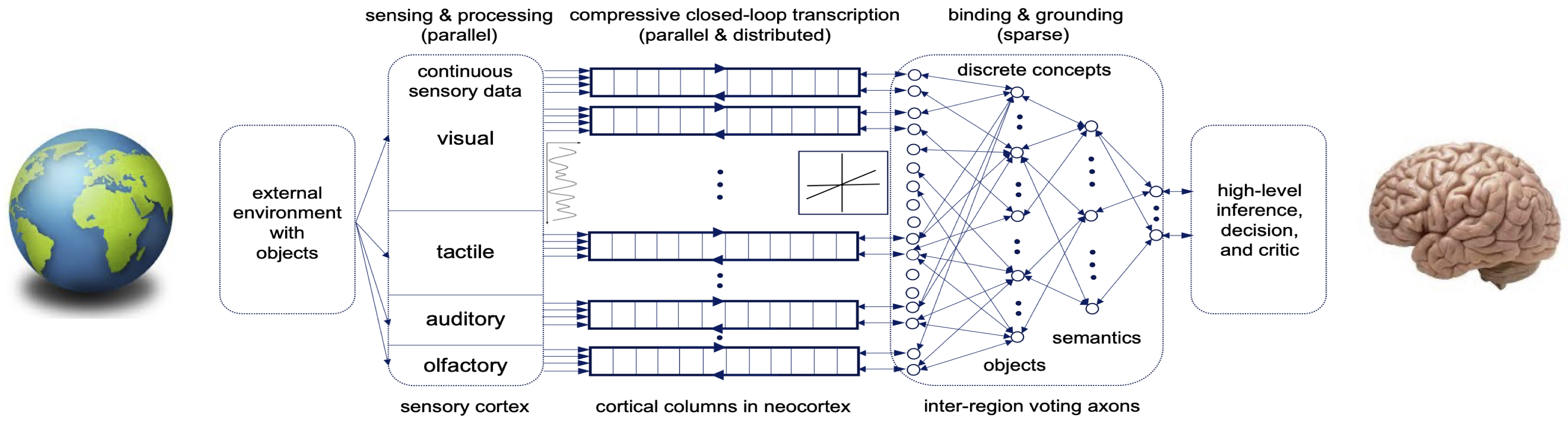
As we have learned from neuroscience, the cortex of our brain consists of tens of thousands of cortical columns [Haw21]. All cortical columns have similar physical structures hence presumably similar functions. They are highly parallel and distributed, though sparsely interconnected. Therefore, we believe that to develop a more efficient and scalable system for more structured representations (memory) of the world, we need to consider architectures that emulate those of the cortex. Figure 9.2 shows such a hypothesized architecture: a massively distributed and hierarchical system consisting of many largely parallel closed-loop auto-encoding modules.5 These modules learn to encode different sensory modalities or different projections of data from each sensory modality. Our discussion in Section 7.5 of Chapter 7 suggests that such parallel sensing and learning of a low-dimensional distribution in an high-dimensional space is theoretically possible. Higher-level (lossy) autoencoders can then be learned based on outputs of lower-level ones to develop more sparse and even discrete higher-level “abstractions”, such as language, of the representations learned by the lower levels.
This distributed, hierarchical, and closed-loop system architecture illustrated in Figure 9.2 shares many known characteristics of the brain’s cortex. Such a system architecture may open up many more possibilities than the current single large open-loop architecture (say the Transformer model). In particular, it would lead to new forward and backward learning mechanisms that result in an ever more structured representation of the sensed data. Such a system would truly emulate how the memory in our brain works. It would also allow us to transform the cuurent ways of scaling machine intelligence to a new continous learning paradigm that achieves or even surpasses the efficiency and effectiveness of intelligence in nature:
As we have discussed at the beginning of this book, Chapter 1, intelligence in nature has evolved through multiple phases and manifested in at least four distinct forms:
All forms of intelligence share the common objective (and characteristic) of learning useful information or knowledge as low-dimensional distributions of high-dimensional data sensed from the open world. Nevertheless, they differ in the specific code books or coding schemes adopted for encoding the useful information or knowledge, the specific information or knowledge learned by the intelligent individual or a group, the computational mechanisms for acquiring and improving the learned information or knowledge, and the physical substrate and implementation of such mechanisms. Using the concepts and terminologies developed in this book, the four stages of intelligence differ in the following three aspects:
Table 9.1 summarizes their main characteristics:
| Phylogenetic | Ontogenetic | Societal | Scientific | |
| Codebook | DNAs | Neurons/Brain | Natural Languages | Math Abstractions |
| Information | Genes | Memory | Empirical Knowledge | Scientific Facts |
| Optimization | Reinforcement | Error Feedback | Trial & Error | Theorize & Falsify |
As we now know, mankind has achieved two quantum leaps in its intelligence:
The language of mathematics freed us from summarizing knowledge from observations only in empirical form and allowed us to formalize knowledge as theories verifiable or falsifiable through mathematical deduction or experimentation. Through hypothesis formulation, logical deduction, and experimental verification or falsification, we can now proactively discover and develop new knowledge that is far beyond what can be learned from the distributions of sensed data. For example, causal relationships cannot be learned from distributions alone [Pea09].
Despite the seeming differences among these different stages of intelligence, the evolution of intelligence shares a common characteristic: they all use certain forms of feedback6 to create and correct information learned, and the feedback and correction are becoming increasingly frequent and efficient through evolution—from open-loop reinforcement to closed-loop self-supervision, from collective trial and error to proactive hypothesizing and falsification.
As discussed in the introduction (Chapter 1), the 1956 “artificial intelligence” (AI) program aimed precisely to study how to endow machines with scientific intelligence, i.e., high-level functions such as mathematical abstraction, causal inference, logical deduction, and problem solving that are believed to differentiate humans from animals:
As we have clarified repeatedly in this book, most technological advances in machine intelligence over the past decade or so, although carried out under the name “AI”, are actually more closely related to having machines realizing learning mechanisms of low-level intelligence largely shared by both animals and humans, including phylogenetic, ontogenetic, and societal intelligence. At these levels, intelligence creates information or empirical knowledge (from empirical data distributions) and conducts inference (or prediction) that is mostly inductive (or Bayesian-like) in nature. Principles and methods introduced in this book aim to reveal mathematical objectives and computational mechanisms behind intelligence at these levels. They provide strong theoretical justification and computational evidence for the following claim:
Machines can learn empirical knowledge and conduct inductive inference.
So far, however, no rigorous theoretical or scientific evidence suggests that these mechanisms alone would suffice to achieve the high-level human intelligence that the original “artificial intelligence” program truly aimed to understand and wanted for machines to imitate or even surpass.
In fact, as of today, we know little about how to rigorously verify or certify whether a system is truly capable of such high-level intelligence, even though the Turing Test, also known as the Imitation Game, was proposed in 1950 [Tur50], as an initial attempt to address the fundamental question:
Can machines think?
However, in Turing’s proposal, the evaluator, or interrogator, is some human. However, most human evaluators have limited scientific training and knowledge, and their conclusions can be rather subjective.
For a long time, a precise definition of such a test was not deemed necessary since machine capabilities were far below those of humans (or even animals). However, given recent technological advances, many models and systems now claim to have reached or even surpassed human intelligence. Therefore, it is high time to develop a scientific and executable definition of the Turing Test, i.e., a systematic and rigorous protocol to evaluate and certify the intelligence level of a model or a system that claims to be “intelligent.”
As Turing argued in his original paper, it is rather difficult to define what “thinking” really means. We may instead start with something arguable more tangible and try to determine first whether the system in question can truly “understand” certain abstract concepts or knowledge. For example, we may try to verify whether an intelligent model or system has truly understood an abstract concept such as:
just to name a few? Or has it simply memorized a massive number of examples of such notions? Note that state-of-the-art large language models still struggle with simple mathematical questions like: “Is 3.11 larger or smaller than 3.9?”8
From this book, we know modern generative AI systems primarily rely on Bayesian (hence inductive) inference to produce their answers. Can machines also truly grasp mathematical induction or general logical deduction and understand its difference from Bayesian induction? How do we verify whether a system truly understands the rules of logical and mathematical deduction and can apply them rigorously? Or, again, has it merely extracted and memorized statistics patterns of such deductions from a large number of instances, such as chain-of-thought data, and simply exploited such patterns inductively during inference? Hence the following question remains an open one:
Is there any difference between memorizing and understanding?
Only by clarifying the difference between these two can we possibly provide a meaningful answer to the question: “Can machines understand?”
Probably much more importantly, how do we verify whether a self-claimed intelligent system is capable of creating abstract concepts or improving its own knowledge proactively via deductive means? For example, can it create new mathematical concepts and discover new physical laws or causal relationships? The connection between understanding and creating can be rather profound, as the physicist Richard Feynman had famously put it:
“What I cannot create, I do not understand.”
It kind of suggests that understanding depends on whether one’s knowledge is grounded from creating it from certain first principles.
Hence, it is high time we develop scientifically sound evaluation methods to determine which of the following categories a system’s intelligence capability belongs to:
To evaluate and distinguish these different levels of intelligence, we suggest that there should probably be at least three different tests, as illustrated in Figure 9.3:
We believe that, for such tests, the evaluator, or interrogator, should not be a single human or an arbitrary group of humans but rather a scientifically certified entity following a scientifically sound protocol and process so that the conclusions would be rigorous and trustworthy.
As we have seen throughout this book, compression has played a fundamental role in gaining information or creating empirical knowledge from data. It is the governing principle and a universal mechanism for identifying a low-dimensional data distribution and organizing the information encoded therein with a structured representation. To a large extent, it explains the current practice of “artificial intelligence” with deep networks, which is largely inductive and Bayesian in nature.10 An outstanding question for future study is whether compression alone is sufficient to achieve all the higher-level deductive intelligence mentioned above. In particular, are mathematical abstraction, causal inference, hypothesis generation, and logical reasoning and deduction some kind of extended or transcended forms of compression? Is there some fundamental difference between learning data distributions through compression and forming high-level concepts and theories through (mathematical) abstraction? Hence we face another open question:
Is there any difference between compression and abstraction?
Only by knowing the difference can we possibly attempt to provide a meaningful answer to the question: “Can machines create knowledge proactively via hypothesizing and deduction?”
To a large extent, Science—and its associated code book, Mathematics—can be viewed as the most advanced and effective form of intelligence. It is largely deductive in nature and unique to educated and enlightened humans. Philosopher Sir Karl Popper once suggested:
“Science may be described as the art of systematic oversimplification.”
We believe that uncovering and understanding the underlying mathematical principles and computational mechanisms of such higher-level intelligence, and successfully reproducing them through machines, will be the final frontier for Science, Mathematics, and Computation altogether!